Should I buy it?
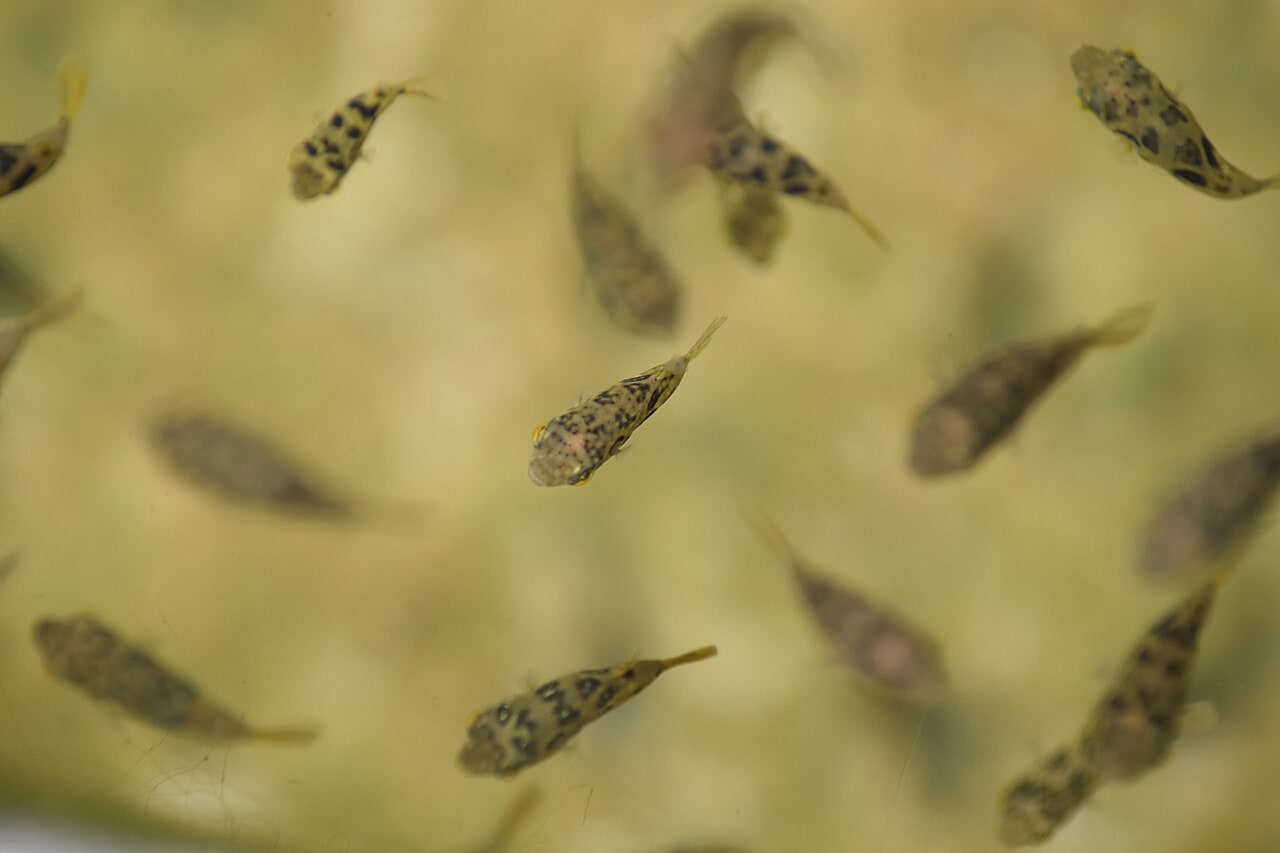
Pea Puffer
Carinotetraodon travancoricus
Also known as: indian dwarf puffer, malabar puffer, Indian dwarf puffer, Malabar puffer
Fishori provides conservative planning guidance, not guarantees.
Based on multiple reputable aquarium care sources with strong agreement. Use the numbers here as planning defaults — your room, water, and routine still shape real-world outcomes.
A 3 cm puffer with a beak built for snails and small shrimp. Nips fins on principle; most working setups are species-only. Any community plan needs every tank mate vetted by behaviour, not just litres.
Best for
Species-only setups 40L or more with dense planting and a snail population for enrichment feeding. One male with two or three females.
Avoid if
You have a community tank with any long-finned fish, slow-moving fish, or shrimp.
Top things that go wrong
- Fin-nipping risk in typical community layouts. Fin-nipping risk toward long-finned or slow tank mates when the school is understocked, bored, or kept in a tank too short to spread out in.
- Mouth gap vs tiny tank mates. Predation risk toward smaller tank mates. The figure that matters is the adult mouth size against the adult prey length, not the juvenile sizes in the shop.
- Specialist husbandry. Kept in pairs or small groups of 6 or more. Buy them at the same time rather than adding one fish at a time.
More issue cards below, after species context.
Common mistakeOne male in a community 'for snail control'. It will fin-nip every tank mate regardless of how many snails are present.
Additional planning warnings
Shrimp & snails
Shrimp: not safe. The fish will eat adult shrimp, shrimp fry, or both, depending on the size of the shrimp.
What most shops don't tell you
- 1.Predation risk scales with gape, night feeding, and crowding. 'they grew up together' is a schedule, not a law.
- 2.Mixing two males in a 40 L planted tank. One dominant fish corners the other within a week, even with hides and sight breaks.
- 3.Adding shrimp or long-finned dither for colour. Pea puffers will pick shrimp off first, then start cropping the fins of anything slower than them.
- 4.Not a polite community nano fish by default. Plan thick planting, heavy feeding variety, and no long-finned or shrimp tank mates.
- 5.Pea puffers are often aggressive and nippy — species-only or heavily structured specialist setups are most predictable.
About this species
Pea puffers are 3 cm freshwater puffers from Kerala that hunt snails and live food. In a tank they nip fins and kill shrimp. Most setups end up species-only.
- American Flagfish60L min · same group, similar adult size
- Clown Killifish20L min · same group, similar adult size
- Marbled Hatchetfish60L min · same group, similar adult size
- Golden Wonder Killifish80L min · same fish family
- African freshwater butterflyfish150L min · same fish family
- Ropefish / reed fish200L min · same fish family
- Senegal bichir300L min · same fish family
- Black ghost knifefish500L min · same fish family
- Agassiz’s dwarf cichlidalso intermediate semi-aggressive, similar tank size
- American Flagfishalso intermediate semi-aggressive, similar tank size
- Apistogramma Borelliialso intermediate semi-aggressive, similar tank size
- Apistogramma Trifasciataalso intermediate semi-aggressive, similar tank size
- Golden Wonder Killifishalso intermediate semi-aggressive, similar tank size
- Tiger Barbalso intermediate semi-aggressive, similar tank size
No reverse lookups on file yet.
Plan grid
Key limits are shown above; this section adds planning detail: pH band, swim level, bioload and activity, and the radar.
Swim zones
Planning trait chart
Six indices for comparing species on paper before you spend.
- Beginner ease41
- Peacefulness0
- Community fit0
- Small-tank fit100
- Hardiness57
- Energy54
Numbers are deterministic planning indices from Fishori fields — not a scientific score of your individual fish.
Common setup sketches
Conservative patterns from Fishori fields — still run the pair checker for every species you add; sketches are not a stocking guarantee.
Avoid “one of everything” baskets — Pea Puffer belongs in a plan built around territory, line-of-sight breaks, and matched water chemistry.
Tank mate intelligence
Species-only is the safest plan: one male with two or three females in a 40 L or larger planted tank. They hunt shrimp, snails, fry, and nip fins on any tank mate, so common community fish like neons, guppies, corydoras, and shrimp will not survive long term.
Pair-level compatibility with this fish as anchor.
Read the blocking rule on each pair page before experimenting.
Do-not-stock combinations on conservative hobby rules.
Compare with
Run a real pair check: Pea Puffer + Bristlenose Pleco
Behaviour, temperament, and what to watch
Prose and lists come from the same record: read temperament first, then glass-level signals so you are not surprised after day three.
Pea Puffer is semi-aggressive: stable in a calm tank, pushy with weaker fish when stressed or crowded. Fin-nipper when the school is understocked, bored, or kept in a tank too short to spread out in. Treats any fish small enough to fit in its mouth as food. Mouth size at adult length matters, not the prey's listed adult size. Holds territory on substrate, in caves, or at the surface film. Break the sight lines with hardscape to keep the resident off the visitor.
Stress / aggression triggers on file
- Small groups or boredom
- Long-finned or slow tank mates
- Bare tanks without structure
Fin nipping: Fin-nipping risk toward long-finned or slow tank mates when the school is understocked, bored, or kept in a tank too short to spread out in.
Predation: Predation risk toward smaller tank mates. The figure that matters is the adult mouth size against the adult prey length, not the juvenile sizes in the shop.
Territory: Holds territory on substrate, in caves, or at the surface film. Break the line of sight with hardscape, and avoid placing the tank where the fish can see its own reflection.
Planted tanks: good — easy plant ideas
In the glass: typical and warning signs
- Moderate pacing — not hyperactive, not motionless.
- Clamped fins, gasping at the surface, hiding non-stop, or refusing food after the first week.
- Rapid breathing when parameters swing — fix ammonia/nitrite first, then reassess mates.
- Chasing one individual repeatedly, torn fins on tank mates, or food theft every feed.
- Corner guarding, flaring, or body-blocking — territory is normal until it becomes relentless.
- Separate or rehome if injuries appear, one fish is pinned, or feeding becomes a daily chase.
- If water is stable but behaviour worsens, reduce stocking or remove the highest-impact species first.
Fish behaviour can vary between individuals and tank setups. Always observe new fish closely after introduction.
Care parameters: water, food, inverts, grouping
Chemistry and group rules sit here so you are not re-reading the same line from tank mate or temperament blocks. Swim level is in the plan grid above.
Hardness
medium
Diet
carnivore
Small invertebrates, frozen bloodworm or daphnia, and protein-rich prepared foods. Rotate the menu and feed by appetite rather than by clock.
Shrimp & snails
Shrimp: not safe. The fish will eat adult shrimp, shrimp fry, or both, depending on the size of the shrimp.
Kept in pairs or small groups of 6 or more. Buy them at the same time rather than adding one fish at a time.
Breeding behaviour depends on the species. Research before you buy a mixed-sex group of this fish.
- Hold 24 to 28 °C steadily on a real thermometer, not the dial on the heater.
- Aim for pH 6.5 to 7.5 and a hardness you can re-test in two weeks. A one-time strip in the shop car park is not a water test.
- Footprint: short wide tanks and tall narrow tanks fish differently for the same volume. Match the tank shape to the swim pattern, not just the litre count.
- Tank volume meets or exceeds 40L published minimum for adults.
- You can stock at least 6 individuals (group welfare).
- Heater can hold 24–28°C without cooking cooler-water tank mates.
- No known fin-nippers paired with long-finned fish unless you accept documented risk.
- No tank mates small enough to fit the adult mouth gap for this species.
Explore and stocking hubs
Same library as the rest of Fishori: tank-mate index for this species, category peers, guides, and litre-based stocking lists where min tank on file is within the hub volume.
Plan with tools
Pair-level rules and multi-fish stocking use the same conservative engine — add this fish in the tank builder only after mates pass pair checks.
Filtration & heating
A 40L minimum tank needs a filter rated for at least 160L/hr turnover and a heater to hold 24–28°C reliably.
Plant suggestions
Pea Puffer does well in planted tanks. Plants compatible with 24–28°C and pH 6.5–7.5:
Profile status: verified · Evidence tier: high · 3 linked source(s). Fishori does not fabricate citations.
Fishori uses conservative planning rules based on these sources.
Confidence is explained in the summary at the top of this page (same tier as here), not repeated below.
How Fishori evaluates compatibility (same logic as pair and tank tools).
- Seriously Fish. Carinotetraodon travancoricus
Primary: aquarium size, water chemistry, behaviour, and compatibility (URL verified in upgrade script; recheck if site content changes).
- FishBase. Carinotetraodon travancoricus
Secondary: taxonomy, distribution, and maximum length in nature; cross-check with aquarium import lines and measured tank parameters.
- Wikipedia. Carinotetraodon travancoricus
Secondary: general species context; verify all husbandry numbers against a dedicated aquarium care sheet and your test kit, not a single table row.
Evidence notes
- The Seriously Fish profile for the binomial in this record was successfully reached as the primary aquarium reference.
- FishBase contributes natural-range size and habitat context. Translate those numbers through your heater, your water report, and your tank footprint before stocking.
- Wikipedia is only cited if the article URL returned OK. Use it for orientation, not as the only care sheet for an import.
- All compatibility text reflects typical hobby experience and the Fishori model. Individual fish, shop stress, and the order tank mates are added in can still defy a single-paragraph label.
- Fishori profiles work from typical aquarium trade sizes and hobby care norms. Specialist site checks and literature review for this species are not yet recorded here, so the ranges on this page are planning numbers rather than guarantees.