Should I buy it?
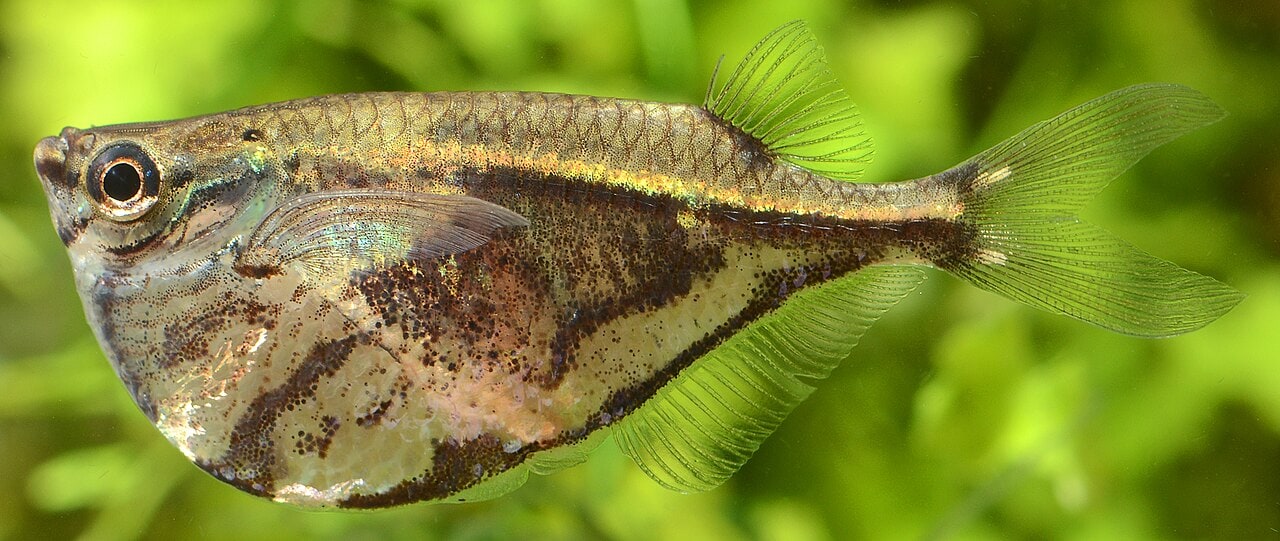
Marbled Hatchetfish
Carnegiella strigata
Typical trade / ID note: Carnegiella strigata
Also known as: marbled hatchet, Marbled hatchet
Fishori provides conservative planning guidance, not guarantees.
Based on typical aquarium care sources; details may vary between setups. Use the numbers here as planning defaults — your room, water, and routine still shape real-world outcomes.
Peaceful top-dwelling tetras with the best gliding-jump behaviour in the hobby. Soft tannin water plus a fully sealed lid is the working setup.
Best for
Soft-water planted community tanks 60L or more with a fully sealed lid and peaceful mid-to-bottom residents below the surface zone.
Avoid if
Your tank lid has any gaps, or you keep surface-active fish that compete for the top zone.
Top things that go wrong
- Group welfare — not a solo display fish. Plan at least **6** together for normal behaviour; smaller groups often mean stress, colour loss, or nipping depending on species.
- Shrimp & snails. Shrimp: compatible in most setups. Cherry shrimp and other dwarf species coexist with peaceful small fish, though baby shrimp are food for almost any fish that gets to them.
Common mistakeAny gap at the surface edge. Hatchetfish can jump several body lengths through a 2 cm gap, especially after a sudden light change.
What most shops don't tell you
- 1.Confirmed jumper. An open tank or even a loose lid loses the school in the first week.
- 2.Open-top tank or a lid with feeding-hole gaps. Hatchets fly out within days.
- 3.Solo or trio purchase. Hatchets shoal tight in groups of six or more; smaller groups never settle and refuse food.
- 4.Confirmed jumper, peaceful otherwise. A group of six or more in a 60L with a flush lid and surface plants works. Hatchets occupy the top of the water column and ignore mid-water tetras and bottom corys entirely.
About this species
Marbled hatchets are surface-dwelling tetras with a flattened keel-shaped belly and pectoral fins that let them jump several body lengths out of the water. The pattern is brown marbling on a silver flank. South American blackwater origin, soft acidic water, and a tight lid are non-negotiable.
- American Flagfish60L min · same group, comparable tank size
- Golden Wonder Killifish80L min · same fish family
- Pea Puffer40L min · same group, similar adult size
- Clown Killifish20L min · same group, similar adult size
- African freshwater butterflyfish150L min · same fish family
- Ropefish / reed fish200L min · same fish family
- Senegal bichir300L min · same fish family
- Black ghost knifefish500L min · same fish family
- Adolfoi coryalso intermediate peaceful, similar tank size
- Bamboo Shrimpalso intermediate peaceful, similar tank size
- Black ruby barbalso intermediate peaceful, similar tank size
- Brown / hockey-stick pencilfishalso intermediate peaceful, similar tank size
- Cardinal Tetraalso intermediate peaceful, similar tank size
- Celebes Rainbowfishalso intermediate peaceful, similar tank size
No reverse lookups on file yet.
Plan grid
Key limits are shown above; this section adds planning detail: pH band, swim level, bioload and activity, and the radar.
Swim zones
Planning trait chart
Six indices for comparing species on paper before you spend.
- Beginner ease38
- Peacefulness90
- Community fit83
- Small-tank fit100
- Hardiness54
- Energy24
Numbers are deterministic planning indices from Fishori fields — not a scientific score of your individual fish.
Common setup sketches
Conservative patterns from Fishori fields — still run the pair checker for every species you add; sketches are not a stocking guarantee.
Rough 90L+ layout: one calm centrepiece, 8–12 small tetras/rasboras, 6–8 corydoras-type bottom fish — verify every name in the pair checker before buying.
Safe directions on file include: Cardinal Tetra, Rummy Nose Tetra, Corydoras Catfish.
Prioritise 6+ of Marbled Hatchetfish in 60L+ with filtration sized for messy feeding — add only mates that already pass pair checks with this species.
Tank mate intelligence
Use the "Often compatible" lists as a shortlist, not a stocking plan. Always run the pair tool and check the footprint of your actual tank first. Verify behaviour for Marbled Hatchetfish against your own reading before you buy.
Pair-level compatibility with this fish as anchor.
Read the blocking rule on each pair page before experimenting.
Do-not-stock combinations on conservative hobby rules.
Compare with
Run a real pair check: Marbled Hatchetfish + Cardinal Tetra
Behaviour, temperament, and what to watch
Prose and lists come from the same record: read temperament first, then glass-level signals so you are not surprised after day three.
Marbled Hatchetfish is peaceful in mixed company.
Stress / aggression triggers on file
- Sudden crowding
- Poor water quality
Fin nipping: Not a habitual fin-nipper, but individuals can still test fins under stress or in a crowded tank.
Predation: Not a predator toward similarly-sized community fish. The usual community caveats about mouth size still apply for very small fry or shrimp.
Territory: Not strongly territorial, but still claims a working area in the tank. Give it room to settle without overlapping the next species' patch.
Planted tanks: excellent — easy plant ideas
In the glass: typical and warning signs
- Often calm on the glass — bursts of movement around food or tank disturbance.
- Shoaling/schooling: most colour and confidence show when the group meets **6+**.
- Clamped fins, gasping at the surface, hiding non-stop, or refusing food after the first week.
- Rapid breathing when parameters swing — fix ammonia/nitrite first, then reassess mates.
- Low listed risk — still watch new introductions.
- Separate or rehome if injuries appear, one fish is pinned, or feeding becomes a daily chase.
- If water is stable but behaviour worsens, reduce stocking or remove the highest-impact species first.
Fish behaviour can vary between individuals and tank setups. Always observe new fish closely after introduction.
Care parameters: water, food, inverts, grouping
Chemistry and group rules sit here so you are not re-reading the same line from tank mate or temperament blocks. Swim level is in the plan grid above.
Hardness
soft
Diet
omnivore
Mixed diet: a quality flake or pellet as the staple, with frozen or live foods two or three times a week.
Shrimp & snails
Shrimp: compatible in most setups. Cherry shrimp and other dwarf species coexist with peaceful small fish, though baby shrimp are food for almost any fish that gets to them.
Six or more. A tight school is the species' resting behaviour; below six they refuse food and stress.
Egg scatterers and schoolers still spawn in stable tanks. Have a plan for the fry, or accept that the parents and tank mates will eat them in a community setup.
- A truly sealed lid. Coverslips for every feeding hole and air gap.
- Surface plants (salvinia, frogbit, dwarf water lettuce) to break the surface and reduce panic jumps.
- Soft acidic water (pH 5.5 to 7.0) with tannins from peat or botanicals for true colour.
- A group of six or more from a single source.
- Tank volume meets or exceeds 60L published minimum for adults.
- You can stock at least 6 individuals (group welfare).
- Heater can hold 24–28°C without cooking cooler-water tank mates.
Explore and stocking hubs
Same library as the rest of Fishori: tank-mate index for this species, category peers, guides, and litre-based stocking lists where min tank on file is within the hub volume.
Plan with tools
Pair-level rules and multi-fish stocking use the same conservative engine — add this fish in the tank builder only after mates pass pair checks.
Filtration & heating
A 60L minimum tank needs a filter rated for at least 240L/hr turnover and a heater to hold 24–28°C reliably.
Plant suggestions
Marbled Hatchetfish does well in planted tanks. Plants compatible with 24–28°C and pH 5.5–7:
Profile status: partially verified · Evidence tier: medium · 2 linked source(s). Fishori does not fabricate citations.
Fishori uses conservative planning rules based on these sources.
Confidence is explained in the summary at the top of this page (same tier as here), not repeated below.
How Fishori evaluates compatibility (same logic as pair and tank tools).
- Seriously Fish. Carnegiella strigata
Primary: species page on Amazon/Rio Negro blackwater origin, jumping behaviour, schooling needs, and feeding (surface foods only).
- Practical Fishkeeping. Marbled Hatchetfish Profile
Secondary: editor coverage of tank setup, surface plant requirement, and the pectoral-fin gliding behaviour.
Evidence notes
- Hatchets feed almost entirely at the surface. Sinking food, flake that drops past the upper third of the tank, and pellet feeds reach mid-water fish before the hatchets see them. Floating micropellets or wet-frozen surface feed are the working diet.
- Wild blackwater origin means tank-bred specimens still want tannin-stained water. A clear tank works for survival, but colour and breeding need peat or alder cones.
- Fishori profiles work from typical aquarium trade sizes and hobby care norms. Specialist site checks and literature review for this species are not yet recorded here, so the ranges on this page are planning numbers rather than guarantees.